

Public lectures
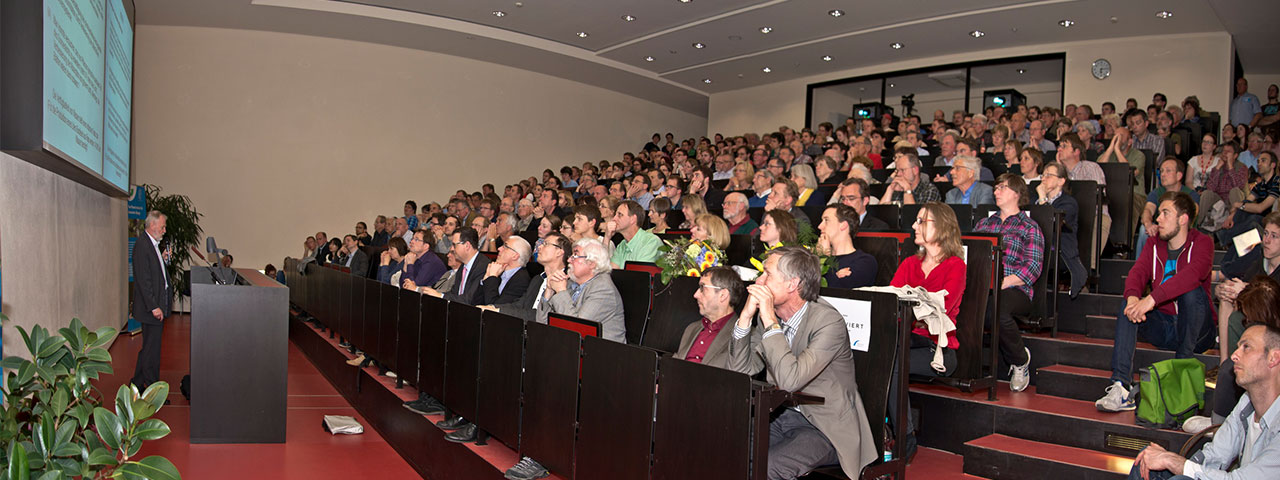
For its ‘Noble Gespräche’ series of public lectures by Nobel laureates, the institutes of Jena’s Beutenberg Campus invite renowned scientists who present their research to a varied audience in terms that laypeople can understand. The lectures, which are held twice a year, deal with current topics in science and technology.
Nobel Prize winner Professor Christiane Nüsslein-Volhard of the Max Planck Institute for Developmental Biology launched the series in April 2005 with a talk about embryogenesis in vertebrates. Since then a large number of exceptional personalities have fascinated their audiences, such as the former president of the Leibniz Association, Professor Rietschel, with his multi-media presentation ‘Immortal music and fatal blood poisoning – the deaths from sepsis of famous composers’ or the physicist Professor Hell, who demonstrated impressively how Abbe’s resolution limit in light microscopy was overcome. In autumn 2011, Nobel laureate Professor Neher treated an enthusiastic audience of more than 300 people to his talk ‘Brain signals: what signals does our brain see and process?’ at the opening event of the ‘Long night of the sciences’ at Beutenberg.
The "Noble Gespräche" lectures are free and will take place in the lecture hall (Abbe- Center Beutenberg, Hans-Knöll-Str. 1, 07745 Jena).
Previous speakers
- Prof. Christiane Nüsslein-Volhard (Nobelpreis 1995)
Entwicklungsbiologie
- Prof. Alfred Pühler
Grüne Gentechnik
- Prof. Anton Zeilinger (Nobelpreis 2021)
Quantenphysik
- Prof. Ferenc Krausz
Quantenoptik
- Prof. James W. Vaupel
Demographische Forschung
Flyer zum Vortrag »
- Prof. Hartmut Graßl
Klimaforschung
Flyer zum Vortrag»
- Prof. Hans Kretzschmar
Prionkrankheiten
Flyer zum Vortrag»
- Prof. Stefan Hell (Nobelpreis 2014)
Lichtmikroskopie im Nanobereich
Flyer zum Vortrag»
- Prof. Ernst Th. Rietschel
Unsterbliche Musik und tödl. Blutvergiftung
Flyer zum Vortrag»
- Prof. Philip Russell
Photonische Kristallfasern
Flyer zum Vortrag»
- Prof. Wolfgang Haber
Naturschutz
Flyer zum Vortrag»
- Prof. Magnus von Knebel Doeberitz
Krebsvirenforschung
Flyer zum Vortrag»
- Prof. Christian Haass
Neurodegenerative Erkrankungen
Flyer zum Vortrag»
- Prof. Erwin Neher (Nobelpreis 1991)
Hirnsignale
Flyer zum Vortrag»
- Prof. Cornelia Denz
Biophotonik
Flyer zum Vortrag»
- Prof. Günter Blobel (Nobelpreis 1999)
Zellevolution
Flyer zum Vortrag»
- Prof. Helmut Dosch
Odyssee im Nanokosmos
Flyer zum Vortrag»
- Prof. Thomas Stocker
Klimaforschung, UN Weltklimarat
Flyer zum Vortrag»
- Prof. Thomas J. Jentsch
Krank durch gestörten Ionentransport
Flyer zum Vortrag»
- Prof. Jens C. Brüning
Stoffwechselforschung
- Prof. Hartmut Michel (Nobelpreis 1988)
Biokraftstoffe
Flyer zum Vortrag»
- Eric Betzig, PhD (Nobelpreis 2014)
Superauflösende Fluoreszenzmikroskopie
Flyer zum Vortrag»
- Prof. Stefan H. E. Kaufmann
Infektionsbiologie
Flyer zum Vortrag»
- Prof. Karsten Danzmann
Gravitationswellen
Flyer zum Vortrag»
- Prof. Meinrat O. Andreae
Klimaforschung
Flyer zum Vortrag»
- Prof. Mark Hay, Ph.D.
Meeresbiologie
Flyer zum Vortrag»
- Prof. Rudolf Jänisch
Stammzellforschung
Flyer zum Vortrag»
- Prof. Ralf Bartenschlager
Virologie, Krebsforschung
Flyer zum Vortrag»
- Prof. Detlef Weigel
Entwicklungsbiologie/Evolutionsforschung
Flyer zum Vortrag»
- Prof. Aydogan Ozcan, Ph.D.
Mikroskopie und künstliche Intelligenz
Flyer zum Vortrag»
- Prof. Reinhard Genzel (Nobelpreis 2020)
Astrophysik - Schwarze Löcher
Flyer zum Vortrag» | Youtube-Link
- Prof. Ricarda Winkelmann und
Prof. Jürgen Renn
Geoanthropologie
Flyer zum Vortrag»
- Prof. Joseph Heitman, Ph.D.
Naturstoff-Forschung
Flyer zum Vortrag